Why You Understand English But Can’t Speak (And How to Fix It)
“I understand everything… but when I try to speak, nothing comes out.”
If I had $1 for every time someone told me this, Daily Talking would be a public company by now.
This is probably the most common frustration in language learning.
And the worst part? It makes people feel like something is wrong with them.
There isn’t.
Most of the time, the issue isn’t intelligence.
It’s not “talent.”
It’s not even vocabulary.
It’s training the wrong skill.
Understanding English and speaking English are related, but they are not the same muscle.
Let’s break down what’s really happening.
Understanding and speaking are different skills
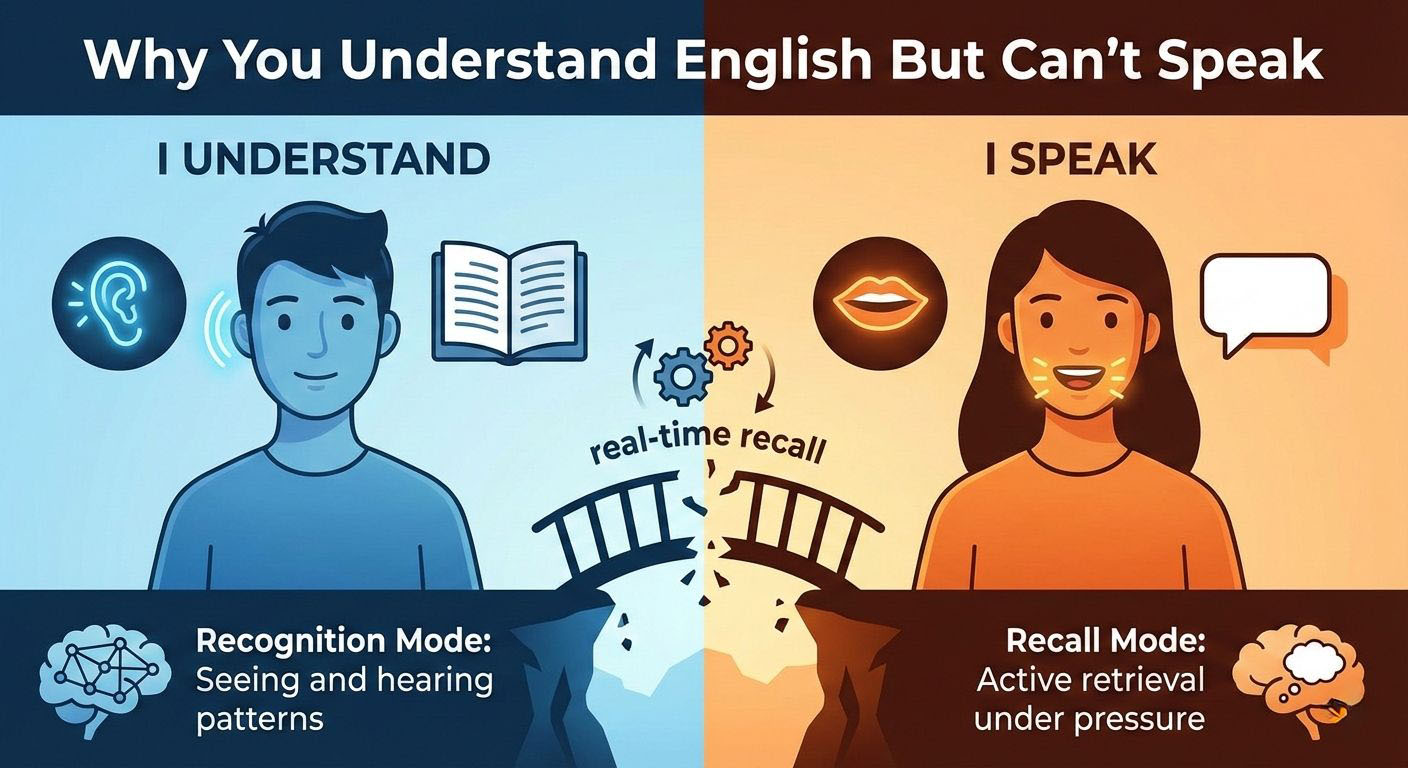
When you read or listen, your brain works in recognition mode.
You see a word and think:
“Yeah, I know that.”
But when you speak, your brain switches to recall mode.
Now it has to:
- choose the right word
- put it in the right order
- apply grammar
- do all of this in real time
- while someone is looking at you
That’s like the difference between:
- recognizing a song when it plays
vs - singing it live on stage with no lyrics
Same knowledge. Very different pressure.
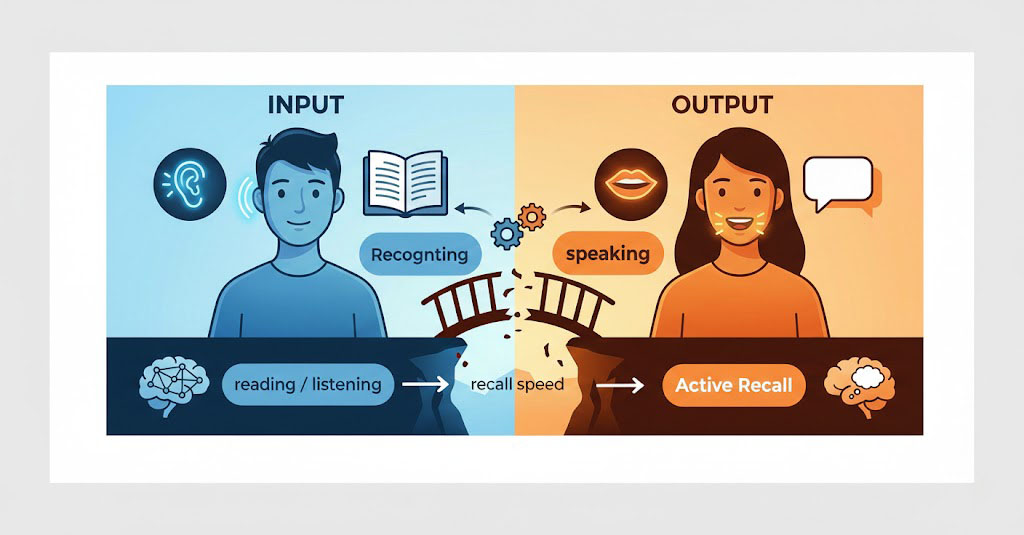
Most learners build huge passive vocabularies.
But their active vocabulary, the one they can access instantly, stays small.
That gap is where frustration lives.
The real bottleneck is recall speed
Here’s something we’ve observed again and again in speaking groups:
People know the word.
They just can’t retrieve it fast enough.
Speaking is not about knowledge.
It’s about speed under light pressure.
The typical mental loop looks like this:
- You start a sentence.
- You search for the next word.
- It doesn’t come immediately.
- Your brain panics.
- You simplify… or stop.
And then you think:
“I can’t speak English.”
But the more accurate sentence would be:
“I can’t retrieve English fast enough yet.”
That’s a practice problem, not a talent problem.
Fear of mistakes quietly shuts your brain down
Now let’s talk about the invisible factor.
A lot of people freeze not because they lack English,
but because they’re trying to produce a perfect sentence.
Perfection is slow.
When you aim for perfect, you:
- rewrite sentences in your head
- restart mid-way
- apologize before finishing
- choose silence instead of risk
Meanwhile, your working memory is overloaded.
Speaking requires cognitive bandwidth.
Fear consumes that bandwidth.
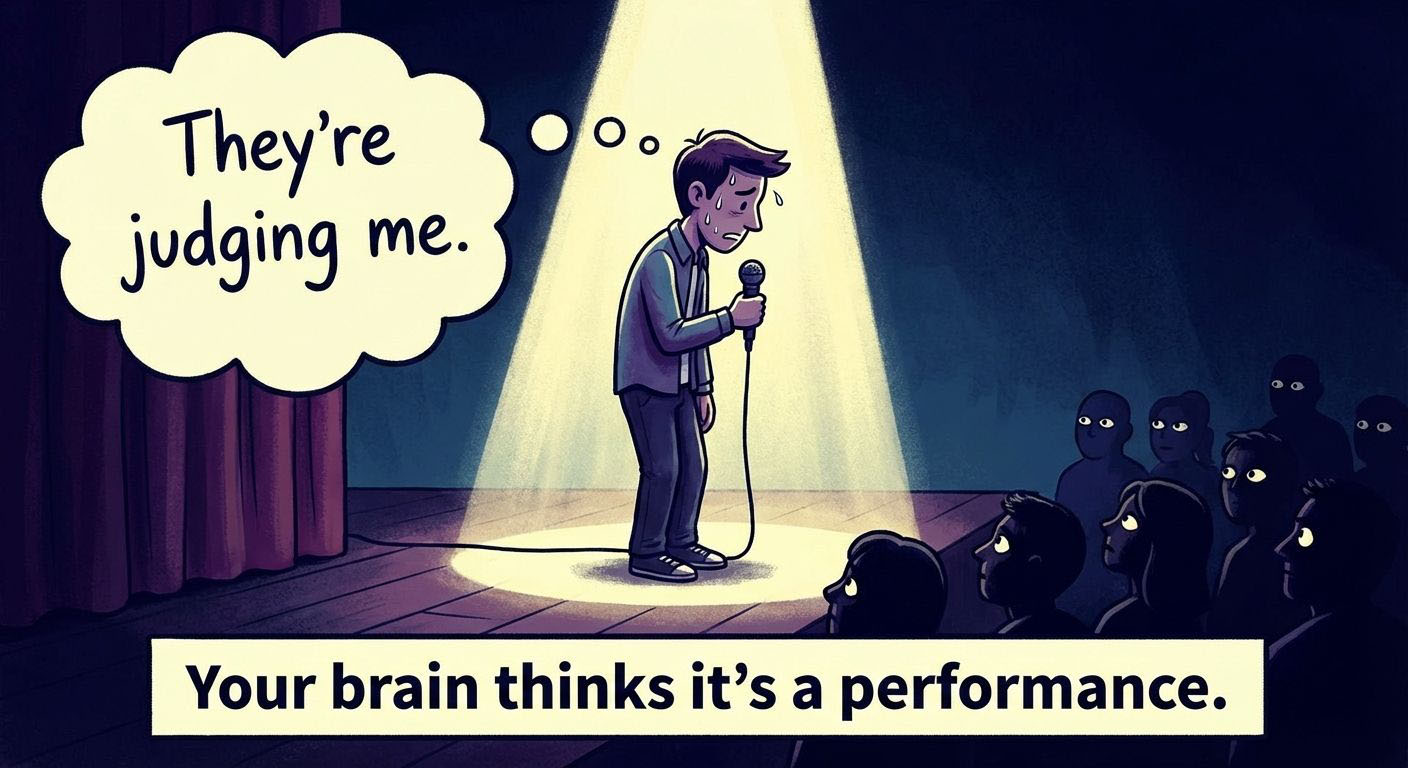
Here’s the uncomfortable truth:
Fluency grows when you allow yourself to sound slightly imperfect.
Messy first. Smooth later.
Not the other way around.
Your practice might be the wrong kind
Let’s be honest.
Most learners spend their time here:
- grammar lessons ✅
- vocabulary apps ✅
- reading articles ✅
- watching videos ✅
- speaking… occasionally 😅
It feels productive.
But speaking is barely trained.
Your brain improves what it repeats.
If 90% of your time is input,
your confidence will reflect that ratio.
At Daily Talking, we see this pattern constantly:
People who studied for years suddenly improve when they simply start speaking more often, even imperfectly.
Not because they learned new grammar.
But because they increased output frequency.
Why small groups accelerate speaking
Speaking environments matter more than most people think.
Many learners try 1-on-1 practice and feel intense pressure.
Every silence feels heavy. Every mistake feels amplified.
Small groups change the dynamic.
1) The spotlight rotates
In a small group (4–6 people), attention naturally shifts.
You’re not “on stage” the entire time.
This reduces cognitive pressure, which improves recall speed.
2) You get natural repetition
In group discussions:
- you hear structures
- you reuse them
- you adapt them
- you try again
Repetition happens organically.
That’s how children learn.
That’s how adults loosen up.
3) Social energy lowers fear
When it feels like a conversation, not an evaluation,
people speak more.
And speaking more is the entire game.
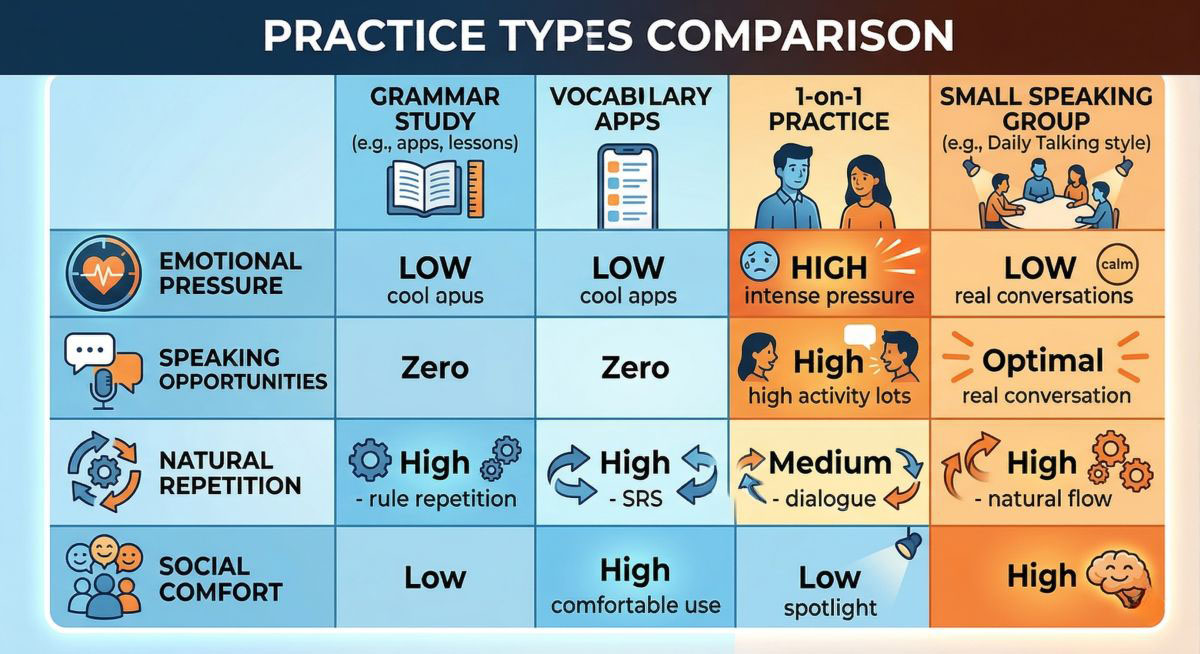
This is one of the main reasons we built Daily Talking around structured small speaking groups instead of random chat rooms.
But regardless of platform, the principle remains:
Low pressure + high repetition = faster speaking growth.
A simple 7-day reset plan
If you feel stuck, don’t overhaul your life.
Run a small experiment for 7 days.
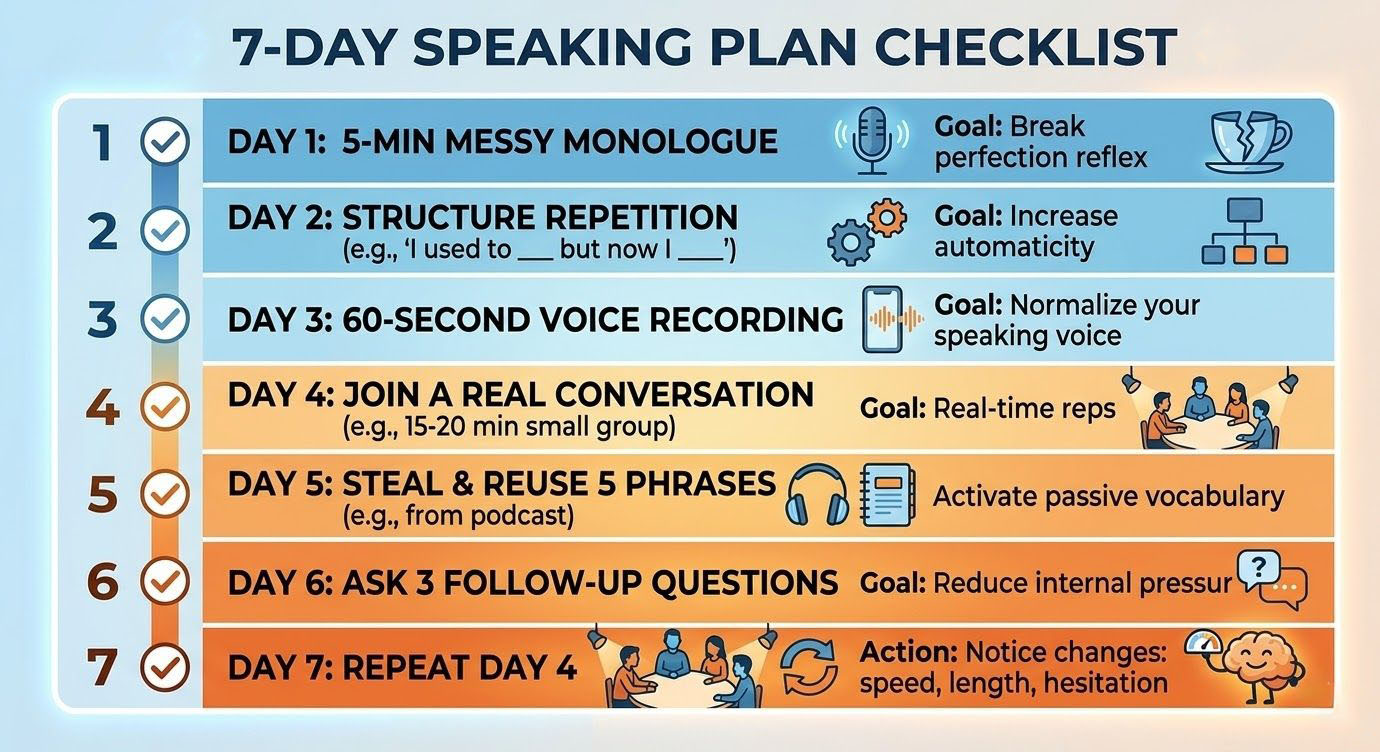
Day 1: 5-minute messy monologue
Pick a simple topic (your week, your job, your plans).
Speak out loud for 5 minutes. No stopping. No editing.
If you miss a word, replace it and move on.
Goal: break the perfection reflex.
Day 2: Structure repetition
Choose one pattern:
“I used to ___ but now I ___.”
Create 10 variations aloud.
Goal: increase automaticity.
Day 3: 60-second voice recording
Record yourself talking about one opinion.
Listen once. That’s it.
Goal: normalize your speaking voice.
Day 4: Join a real conversation
Even 15–20 minutes in a small group is enough.
Goal: real-time reps.
Day 5: Steal and reuse 5 phrases
From a podcast or show, collect phrases like:
- “That makes sense.”
- “To be honest…”
- “What I mean is…”
Use them the same day.
Goal: activate passive vocabulary.
Day 6: Ask 3 follow-up questions
Shift focus outward.
Curiosity reduces self-consciousness.
Goal: reduce internal pressure.
Day 7: Repeat Day 4
Notice what changed:
- starting speed
- sentence length
- hesitation
Small improvements compound.
Final thought
If you understand English but can’t speak it, you are not behind.
You are simply overtrained in input and undertrained in output.
Fix recall speed.
Lower pressure.
Increase repetition.
That’s it.
And if you want an easier environment to do that, look for small, consistent speaking groups where the goal is conversation, not correction.
Confidence doesn’t arrive before speaking.
It grows because of it.