Best English Conversation Topics for Language Learners
One of the hardest parts of English speaking practice is not always grammar or vocabulary.
Sometimes the hardest part is simply knowing what to talk about.
You join a conversation, say hello, introduce yourself, and then suddenly the conversation slows down.
This happens to many learners.
The good news is that you do not need advanced or complicated topics to practice English well. Simple, familiar topics are often the best.
What makes a good English conversation topic?
A good conversation topic should be easy to understand, easy to answer, and open enough for different opinions.
It should help people speak naturally.
The best topics usually:
- Are related to daily life
- Give everyone something to say
- Do not require expert knowledge
- Can lead to follow-up questions
- Feel relaxed and friendly
- Match the group’s English level
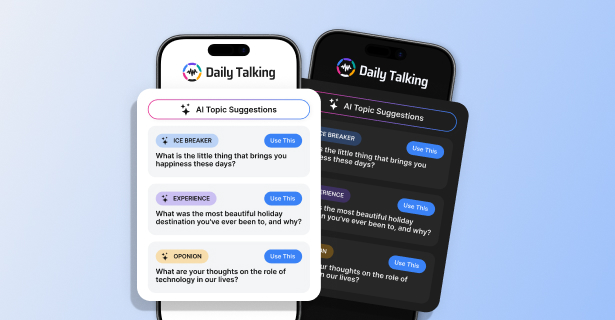
Daily Talking uses AI-powered topic suggestions to help conversations continue naturally. The app can suggest topics based on interests and what people have been talking about, helping groups avoid awkward silence.
1. Daily life
Daily life is one of the easiest and most useful conversation topics.
You can talk about:
- What you did today
- Your morning routine
- Your weekend plans
- Your favorite part of the day
- Something interesting that happened recently
Example questions:
- What did you do today?
- What do you usually do after work or school?
- Do you prefer mornings or evenings?
- What is one small thing that made you happy recently?
These topics help you practice real English you can use often.
2. Food and cooking
Food is a great topic because everyone has something to say.
You can talk about favorite dishes, local food, cooking habits, restaurants, or food from different countries.
Example questions:
- What is your favorite food?
- Can you cook?
- What food is popular in your country?
- Do you prefer eating at home or eating out?
- Is there a food you really do not like?
Food topics are especially useful in international groups because people can share culture naturally.
3. Travel and countries
Travel is one of the most popular English conversation topics.
Even if someone does not travel often, they can still talk about places they want to visit.
Example questions:
- Which country would you like to visit?
- What is your favorite city?
- Do you prefer beach holidays or city trips?
- What should tourists see in your country?
- Have you ever had a funny travel experience?
This topic also helps learners practice describing places, experiences, and preferences.
4. Hobbies and free time
Hobbies make conversations more personal and enjoyable.
You can talk about what you like doing, what you want to try, or how you spend your free time.
Example questions:
- What do you like doing in your free time?
- Do you prefer indoor or outdoor activities?
- What hobby would you like to start?
- Do you like sports?
- How do you usually relax?
Hobby topics are useful because they often lead to longer conversations.
5. Movies, music, and books
Entertainment topics are easy and fun.
They help learners share opinions without needing very advanced vocabulary.
Example questions:
- What kind of movies do you like?
- What was the last movie you watched?
- Who is your favorite singer or band?
- Do you prefer movies or series?
- What book would you recommend?
These topics are also good for practicing phrases like “I recommend,” “I prefer,” “I think,” and “In my opinion.”
6. Work and study
Work and study topics are useful, especially for learners who need English for professional or academic life.
Example questions:
- What do you do?
- What are you studying?
- What is your dream job?
- Do you prefer working from home or in an office?
- What skill would you like to learn?
Keep these conversations light. The goal is speaking practice, not a job interview.
7. Opinions and simple debates
Opinion topics help learners practice explaining ideas.
Start with simple questions.
Example questions:
- Is it better to live in a big city or a small town?
- Do you prefer online shopping or shopping in stores?
- Is social media useful or harmful?
- Should people learn more than one language?
- Is it better to travel alone or with friends?
These topics help you practice agreeing, disagreeing, and giving reasons.
8. Fun questions and games
Sometimes the best conversation topics are not serious.
Fun questions make people relax and speak more naturally.
Example questions:
- Would you rather travel to the past or the future?
- If you could have one superpower, what would it be?
- What is the funniest thing that happened to you recently?
- If you could live anywhere, where would you live?
- What is one thing you cannot live without?
Daily Talking also includes trivia games that help groups keep speaking in a fun way. The app describes trivia as a way to laugh, debate answers, and speak English without even realizing it.
How Daily Talking helps you find topics
Daily Talking is designed to make group speaking practice easier.
When the conversation slows down, AI-powered topic suggestions can give your group new ideas. These suggestions help you keep talking without feeling stuck.
You can also use games and activities to make practice more fun and natural.
This is useful because the goal is not to create perfect sentences.
The goal is to keep communicating.
Final thought
The best English conversation topics are simple, familiar, and easy to answer.
You do not need complicated subjects to improve.
Talk about daily life, food, travel, hobbies, movies, work, opinions, and fun questions. These topics help you speak more naturally and build confidence over time.
With Daily Talking, you can practice these topics in small voice groups with real people, AI topic suggestions, subtitles, translations, and games.
So the next time you do not know what to say, you do not have to stop.
You just need a good topic and a friendly group to speak with.