Introducing AI Talk in DailyTalking 2.0.0
You understand English. You can read it, watch it, and maybe even write it at work. But when it is time to speak, you still need one thing: a moment to actually use the language out loud.
That moment does not always arrive when your group is online, when a friend is free, or when you feel brave enough to start.
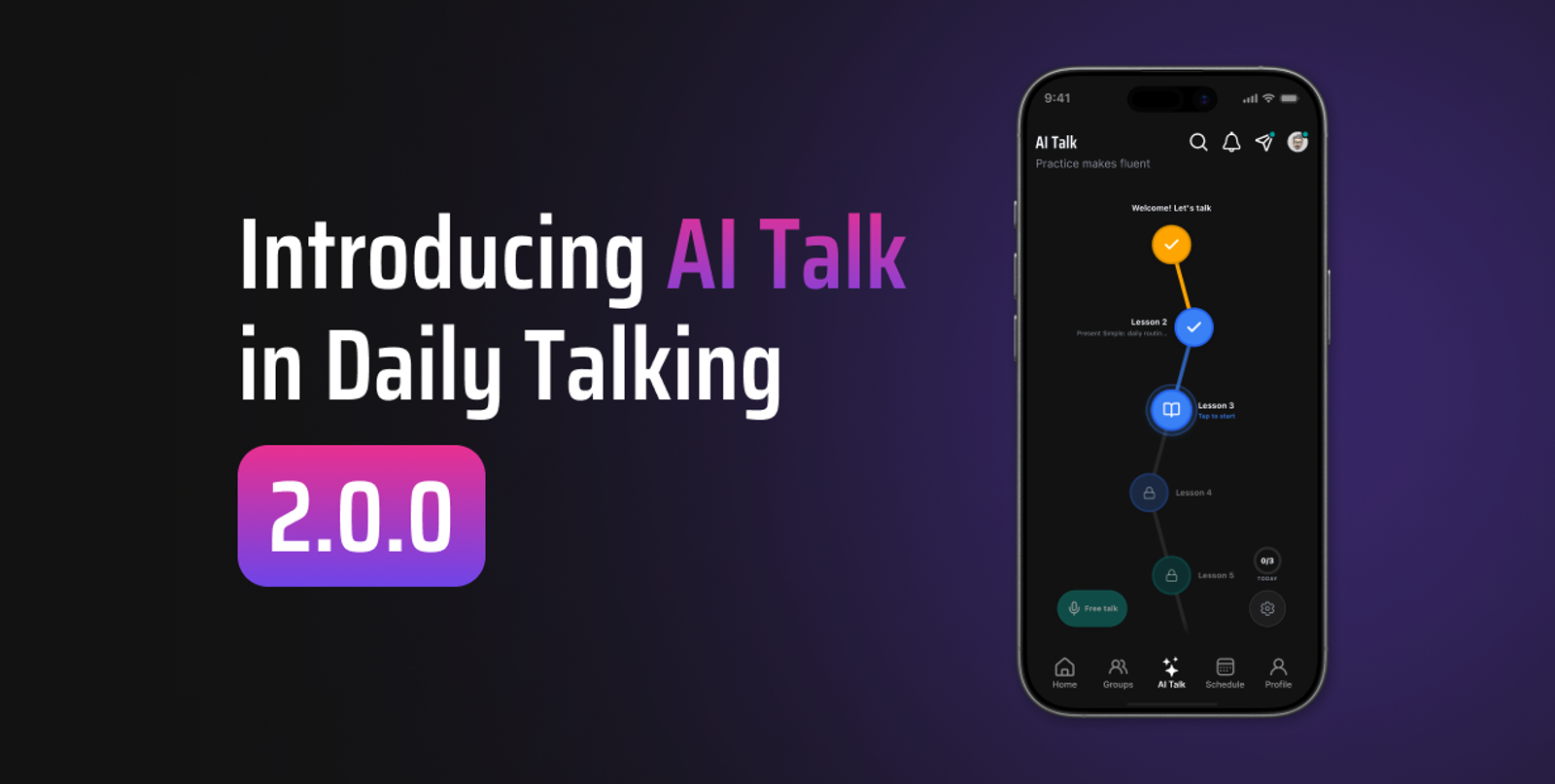
AI Talk is the new speaking-practice feature in DailyTalking 2.0.0. It is built for that gap.
A private voice conversation. As you practice, AI Talk gets a clearer sense of you, and the lessons that follow take shape around your level and your goals. You can speak today, then walk into a real group with a little more ease.
Today you can speak. You don't need a partner first.
You get a place to start now, without waiting for the perfect person or the perfect mood.
A usual day looks like this:
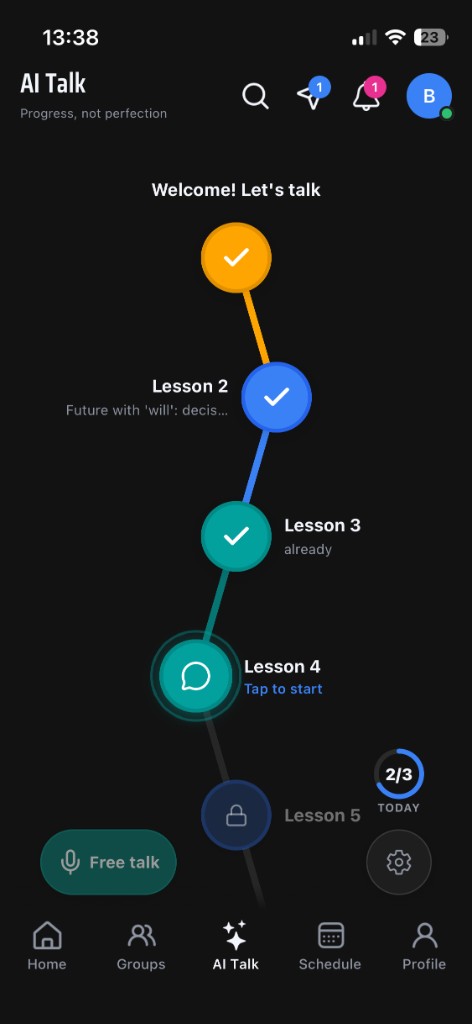
- Each lesson is about 3 minutes.
- Your daily goal is 3 lessons.
- When you just want to chat, Free Talk is there, including after you have finished today's lessons.
You are not opening another generic course. As you practice, the talks start to fit how you sound and why you are learning.
It is not a replacement for real people. It is the on-demand part of a habit that still ends with real conversation.
“I'll speak later” is how later never comes
Many learners postpone speaking because practice is awkward to arrange.
Maybe nobody is free today. Maybe a one-on-one lesson feels intense. Maybe you have ten minutes and a blank mind. Or maybe you want to speak, but the first sentence will not come.
When that happens often, speaking becomes something you will do later.
And later becomes next week.
AI Talk makes the first step smaller: sit down, talk for three minutes, and leave having actually spoken, not postponed it again.
The more you practice, the more the next lessons fit you.
You do not get a finished, personal path on day one. You start talking.
As you practice, AI Talk understands you better: how you sound, and what you are here for. Work, school, travel, everyday life, moving abroad, an exam. The lessons that come after take shape around your level and your goals. Meetings feel different from a trip. If your reason changes, say so. What follows can follow that.
A few conversations in, this is no longer the same course everyone else gets. That is personalized speaking practice.
Some lessons are grammar you will use in real talk. Some are words you will actually say.
If you already speak well, the path does not stop at “you are fluent enough.” There are lessons for putting thoughts across more clearly: what + why + example, opinion + reason + example, problem + action + result, compare + contrast + preference. The point is not another tense drill. It is to sound organized and convincing when you speak.
The lesson path is English first. For other languages we are collecting demand: in the app you can request lessons for that language. Until a path exists, you are not locked out. Free Talk still works, so you can speak today.
A daily goal you can actually finish
Each lesson is a short spoken conversation, not a worksheet. The partner explains today's point in a few sentences, then you use it while you talk about something real. Near the end there is a goodbye, and you see how you did.
Stay to the end if you want the lesson to count. Leave early and it waits for you.
Three minutes is short on purpose. A long class is easy to postpone. A short talk is hard to talk yourself out of.
Free Talk is the other door. Same three minutes, no lesson target. Pick a topic (work, travel, daily life, food, health, people) or just start. Use it to warm up, to keep going after today's three lessons, or on a day when you do not want a structured path.
Lessons give you a sequence. Free Talk keeps the habit alive. The path, the next lesson, and Free Talk all sit on the same screen. You do not have to hunt for a way to speak.
Too fast? Too hard? Change the room.
You should not have to suffer through a talk that is too fast, too hard, or in the wrong voice.
You choose:
- How simple or rich the language is, from very simple to very hard. The first talks suggest a starting point. You can change it whenever a conversation feels off, even in the middle.
- How fast the partner speaks: slow, normal, or fast. Hard language and slow speech can live together. So can simple language and a natural pace.
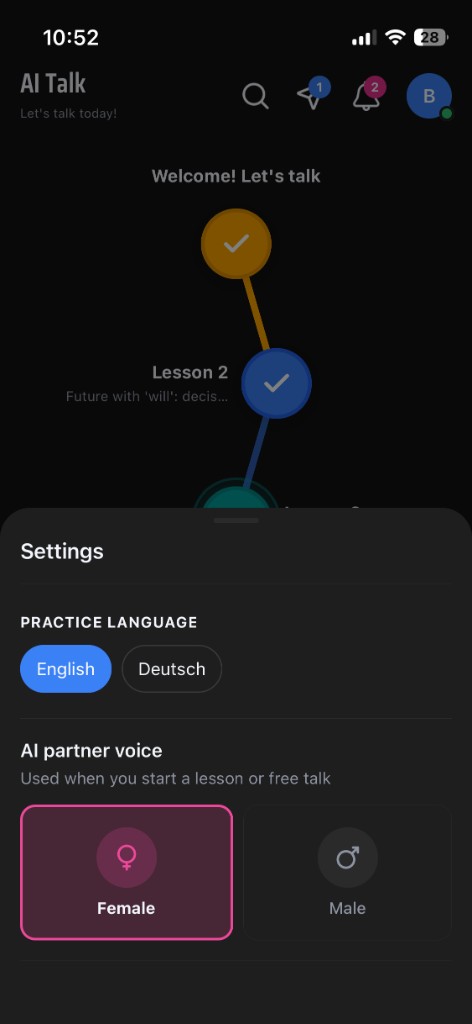
- A female or male partner voice.
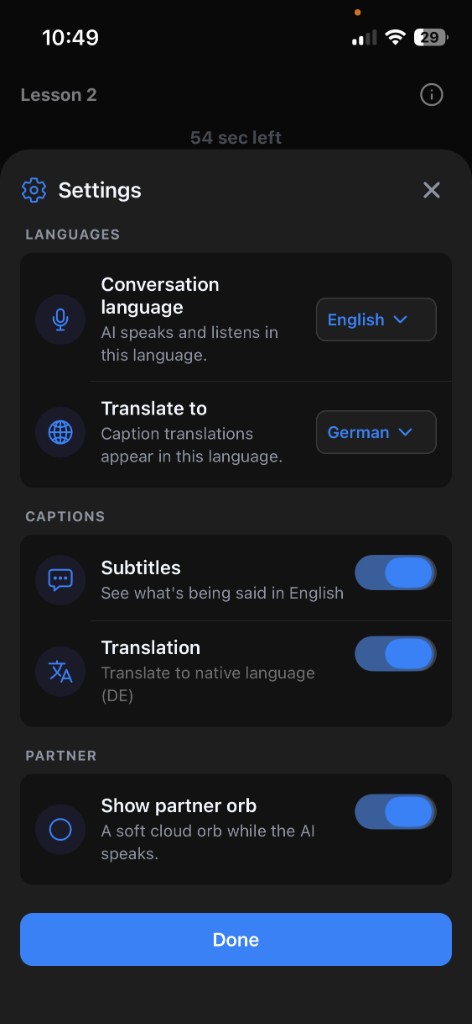
You also choose how language works in the room. Three separate things, because real learners need all three:
- The language you are practicing: English, or another language you are learning. This stays the goal of the session.
- The language you speak with the partner, usually the same, for immersion. If today feels like too much, you can switch to a language you already know. The partner still helps you try phrases in the language you are learning. It does not turn into a casual chat in your comfort language.
- Subtitle translation: see what was said, and optionally read it in your language. You can turn captions off, translations off, or keep both.
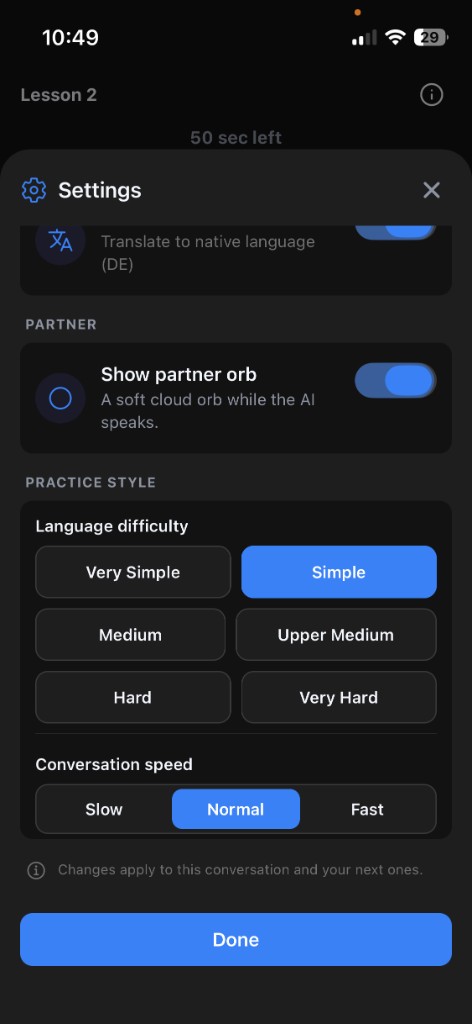
And when your mind goes blank, that familiar “I know this, I just cannot say it,” you are not stuck:
- Hint, when you need a line to start from.
- How do I say…?, when the sentence exists in your language and not yet in the one you are practicing.
- Slow down, when you need the last line again.
- A tap on a caption, when you want the grammar or a clearer way to say it.
This is a conversation, not a voicemail. If you start talking, you can take the turn.
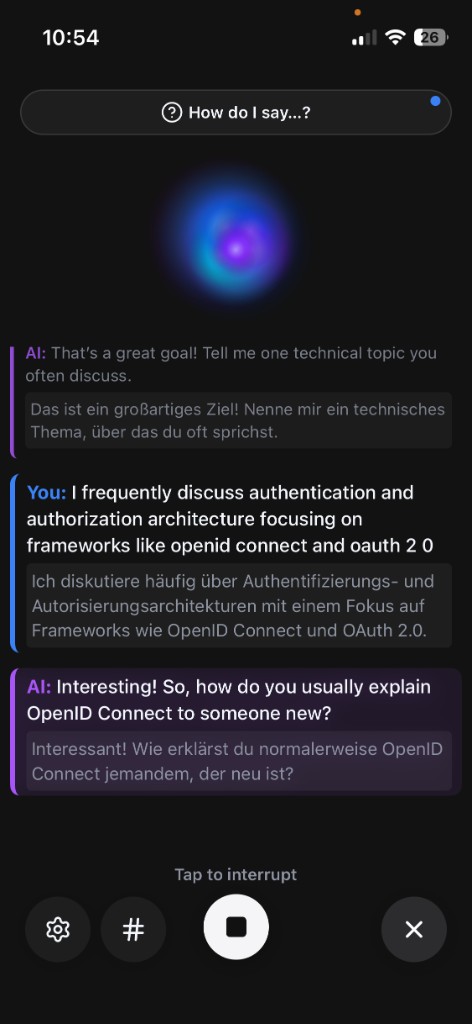
The app itself can stay in your language (English, Turkish, Polish, Spanish, German, Italian, French, Portuguese, Russian, Ukrainian) while you practice another.
No red pen. Just today's win.
You do not get a scolding. You get today's win: what you practiced, a word that landed, one thing that got better, one thing to try next time.
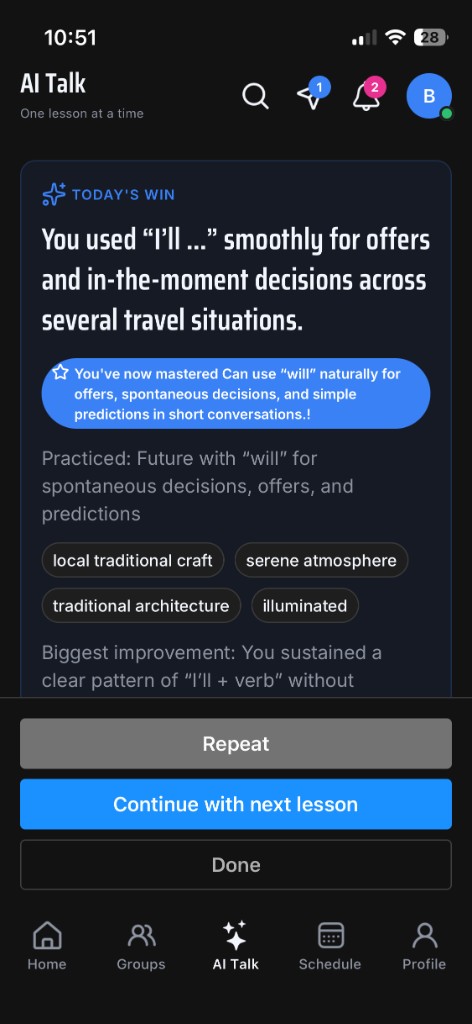
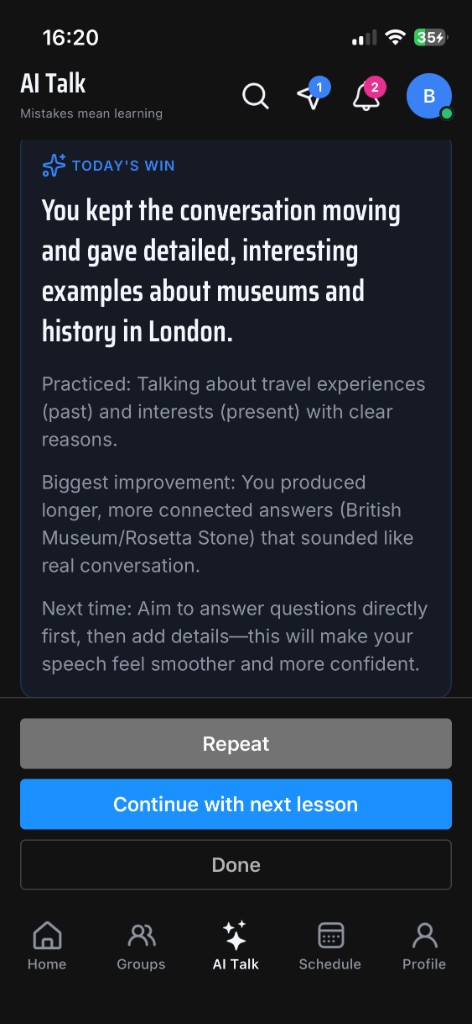
If you want more, it is there: a clearer version of a sentence you said, a better word, a note on how the talk went. Explanations can be in your language. The examples stay in the language you are practicing.
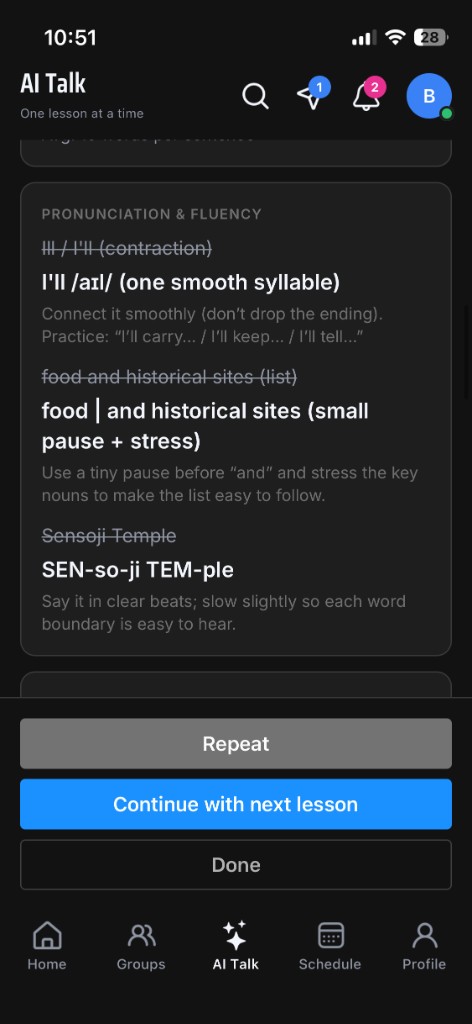
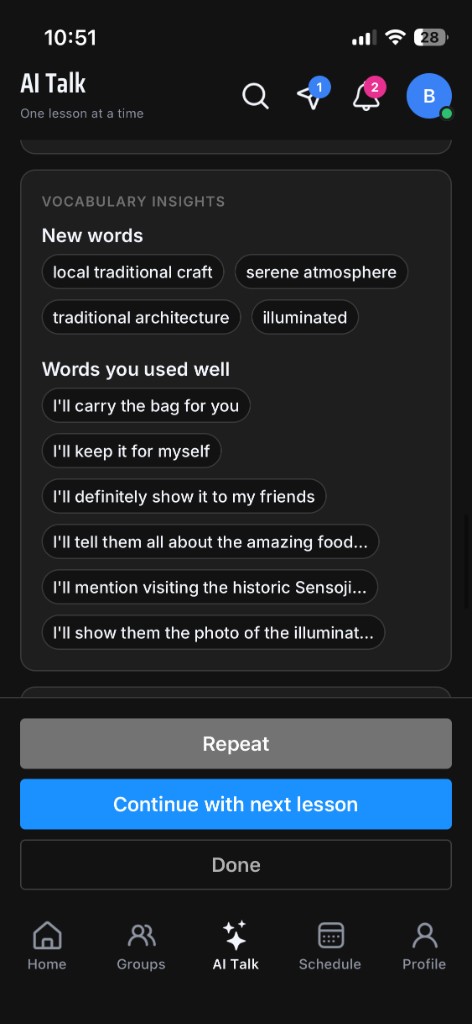
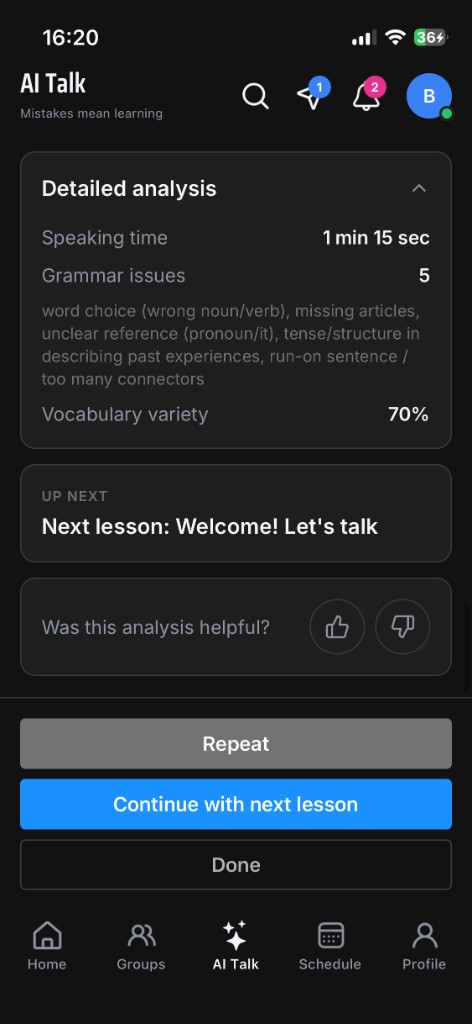
Then the useful next step: a group of real people, if you want one. AI Talk is the warm-up. The group is where the language has to live.
Tapping the right word is not the same as saying it
Traditional language apps are good at keeping you in contact with the language: a streak, a tree of skills, a right-or-wrong tap.
They are weaker at the thing most adults actually need: saying something out loud, in time, when nobody wrote the sentence for you.
A course can tell you that you “know” a tense because you chose the right option. That is useful. It is also not the same as using that tense while talking about your Tuesday.
A classroom or a tutor can give you real speaking. They cannot sit in your pocket at 10 p.m. when you finally have three minutes.
AI Talk sits in the middle: you speak, practice starts to fit why you are learning, it is short, and when you are ready there is a live group in the same app.
You do not have to quit the app you already like. Use it to study. Use AI Talk to speak. Use a Daily Talking group to be understood by another human.
ChatGPT can chat. This is built for speaking practice.
You can open ChatGPT, Gemini, Claude, or a phone's voice mode and say “practice English with me.” That can help you start.
It will not, on its own, give you a speaking path that fits you.
A general assistant will role-play, correct a paragraph, or talk about your day. It will not get a clearer sense of you as you practice, then shape the next lessons around your level and your goals. It will not keep “the language I am learning,” “the language we are speaking right now,” and “the language on my subtitles” as three different choices. It will not finish a talk and offer you a real group in the same place.
The honest question is not which model is smarter. It is whether practice is still generic every time you open it.
With a general chat, you practice when you remember to invent a prompt. With AI Talk, the next lesson is already waiting, and the group is still there when you want people.
For why live conversation still matters after any of this, read why speaking with real people works differently from chatbot-only practice.
Common questions
How does AI Talk personalize the lessons?
It does not hand you a finished, personal path on day one. You start talking. As you practice, it gets a clearer sense of your level and why you are learning. The lessons that come after take shape around that. If your reason changes, say so.
Does this replace talking with real people?
No. AI Talk is the part you can start when nobody is free. A live group is still where the language has to live.
What is the difference between a lesson and Free Talk?
A lesson has a point to use, then a goodbye. Free Talk is the same three minutes with no lesson target. Pick a topic or just start. Both count as speaking. Only a finished lesson counts toward today's three.
I am not learning English. Can I still use it?
The lesson path is English first. For other languages you can request lessons in the app. Until a path exists, Free Talk still works.
What if I freeze and cannot think of a sentence?
Use Hint when you need a line to start from. Use How do I say…? when the sentence exists in your language and not yet in the one you are practicing. Use Slow down to hear the last line again. Tap a caption if you want the grammar or a clearer way to say it.
Will I get a score or a level badge?
No. You get today's win: what you practiced, what landed, one thing to try next time. If you want more detail, it is there. It is a note on how you spoke, not a grade.
Can I change how hard or how fast it is?
Yes, including in the middle of a talk. Difficulty and speed are separate. You also pick a female or male voice, and you can keep the app in your language while you practice another.
Start with one sentence
Start talking. Talk like yourself.
The next day, try three short lessons. If the partner feels too hard or too fast, change that. If you freeze, ask for a hint. If you want to wander, open Free Talk.
You do not need perfect conditions.
You need one sentence, out loud, today. AI Talk is there for that sentence. Real conversations are there for the reason you started.